Daggermouth Review: Is the Hype Justified? (Honest & spoiler free)
This post contains affiliate links. If you purchase through one of my links I may earn a small commission at no extra cost to you. I only ever recommend books and products I genuinely love. For more information see my full disclosure policy.
There’s a particular kind of hype that can be both the best and worst thing for a book, and Daggermouth arrived with it in spades. H.M. Wolfe’s dark dystopian romance had completely taken over my Threads feed — glowing review after glowing review, readers calling it a six-star read and crediting it with pulling them out of reading slumps they thought had no end. I tried to hold off. But the FOMO took hold and I failed. The irony is that I picked it up in the middle of one of my own reading slumps, and yet within two days I’d devoured the whole thing.
That tells you something important upfront: this book grips you. Even if it doesn’t completely land the way you hope it would, you keep turning pages.
And for a slump read? That alone earns it serious credit.
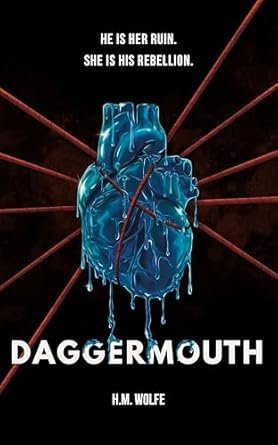
Daggermouth – The Heart Duology
H.M. Wolfe · Dark Dystopian Romance · Book 1
Spice Rating: 🌶️🌶️🌶️
Tropes
True enemies to lovers · Forced proximity · Political Marriage · Morally grey FMC · Masked MMC · Rise of the Oppressed
Best for
Readers who love political dystopia with romantic tension, fans of The Hunger Games or The Handmaid’s Tale, and anyone looking for a reading slump cure with actual substance
Daggermouth is the first book in The Heart duology by H.M. Wolfe, and from page one it’s clear this is not a soft dystopia. Set in a tightly controlled world of New Found Haven where hierarchy is everything, surveillance is constant, and the rules exist to keep people exactly where the system wants them, Daggermouth is laced with tension. It’s brutal in places, sharp around the edges, and the stakes feel very real very quickly.
Originally self-published, Daggermouth built such momentum through word of mouth that it was picked up for traditional publishing. The new edition is available to preorder now from Waterstones ahead of its June release. Copies of the original print are available in limited supply via Amazon UK.
What Daggermouth Gets Absolutely Right
At its core, this isn’t just about staying alive inside a dangerous system. It’s a pointed look at what happens when power goes unchecked, when women are treated as assets rather than people, and when choice itself becomes something the state can punish. The romantic thread unfolds under that pressure, leaning into genuine hostility and imbalance rather than soft-edged rivalry.
If you gravitate towards dystopian stories with political bite, morally grey choices, and relationships built under serious constraint, it’s very easy to see why readers across Threads and BookTok have been calling this one a six-star read.
The premise takes that world and gives it a razor edge: a story about power, survival, and what people are willing to do, and become, when the system leaves them no good options.
It’s the kind of concept that makes you wonder why it hasn’t been done quite like this before, and H.M. Wolfe executes it with real confidence. There’s creative ambition here that pays off.
Main Characters That Will Live in Your Head, Rent Free
This is where Daggermouth quietly does some of its most impressive work, and where I think it deserves far more credit than the hype gives it.
At the centre of everything are Shadera Kael and Greyson Serel, and they are, individually, phenomenal characters before they are ever a couple. Shadera is a woman in her thirties with a mercenary’s skill set and a past that has carved her into someone who cannot afford softness.
She’s morally grey in the truest sense, not in the romanticised, aesthetically dangerous way that fantasy sometimes defaults to, but in the way of someone who has made hard choices for complicated reasons and lives with every one of them.
She walks into this story as an assassin who fails her mark, and what follows is her navigating a world that suddenly has her trapped right at its corrupt, surveilled heart. The way her walls come down, slowly, reluctantly, almost against her will, is one of the quiet pleasures of the book.
Greyson is her equal in complexity. Publicly, he is the regime’s executioner: the flawless, masked heir who carries out the state’s violence with precision. Privately, he’s something else entirely, entangled in secrets that run deeper than his father’s presidency, caught between the person the system made him and the person he might choose to be if choice were ever actually on the table.
He is, technically, a monster. But Wolfe is careful to show us that monsters aren’t born, they’re built. His arc is one of the most interesting in the book, precisely because it refuses to resolve cleanly.
Together, their dynamic is combustible in the way that only works when both people are genuinely dangerous to each other, not just physically, but in every way that matters.
Plus there’s a supporting cast you’ll fall for too
Jameson made my heart ache. Not in a performative, dramatic way, but in that quiet, persistent way where you find yourself thinking about a character hours after you’ve put the book down. There’s a tenderness to him underneath everything, and the way the story slowly reveals it felt earned rather than convenient.
Captain Mikel was a masterclass in ambiguity. Right up until the end, I genuinely couldn’t tell you whose side he was on, and that tension was delicious. He’s the kind of character who makes you realise you’ve been holding your breath without noticing.
Elara is perhaps the most quietly devastating character in the book. She slips into the background in a way that initially reads as minor, but is actually deeply intentional: a portrayal of the silence that abuse causes, and the particular pain of watching someone you love retreat into it. She doesn’t need dramatic scenes to leave a mark. She leaves one anyway.
And President Maximus. There are villains you love to hate, and then there are villains you simply hate, with every inch of your soul, with a visceral, full-bodied revulsion that tells you the author got it exactly right. Maximus is the latter.
Wolfe has built a cast that functions as a complete ecosystem. They push against each other, protect each other, fail each other, and every one of them feels like a real person making real choices under impossible circumstances.
From the writing desk

The Women Who Keep Me Writing

Finding My Voice Again: The Story Behind The Author
True Enemies to Lovers — Or Just a Really Good Twist?
Daggermouth is marketed as a true enemies to lovers story, and I went in expecting exactly that: two people on irreconcilably opposite sides, ideologically at war, forced into proximity and slowly, painfully undone by it. What I got was something more complicated and, for me, less satisfying as a romantic arc.
The central tension is built on the premise that Shadera is sent to kill Greyson. But they have never met before she pulls the trigger. The enmity is professional. Transactional. She has been assigned a target, not a nemesis. And once they are forced together and she begins to see who Greyson actually is beneath the mask and the regime’s machinery, the story reveals itself to be less about enemies and more about assumptions.
Shadera doesn’t so much fall for her enemy as she discovers that the man she had learned to hate through government broadcasts is not who she thought he was, and is just as trapped as those in the Boundary. There’s real thematic richness in that. It’s essentially a story about not judging a book by its cover, about what we’re told to believe versus what we find when we look properly. As a character arc, it works beautifully.
As an enemies to lovers romance, though? It gave me pause. Because a late revelation effectively dismantles the foundation their conflict was built on, and while that twist lands with real impact, it also left me sitting with a nagging feeling: what were we actually rooting against this whole time? The heat between them is real. The tension is real. But by the end, the “enemies” label feels less like something they’ve fought through and more like something that was never quite as solid as the marketing suggested.
None of this makes the romance bad. Greyson and Shadera have genuine chemistry, and Wolfe writes their push and pull with a tension that does hold you. But if you’re coming in hungry for a slow-burn built on deep, mutual antagonism, two people who truly stand for opposing things forced to reckon with each other, you may find yourself, as I did, a little adrift by the end. Warmed by what you got. But quietly wondering what could have been if the enemies had been allowed to be enemies for just a little longer.
The Moments That Genuinely Surprised Me
The plot itself is solid. There are moments, which I won’t spoil, where I gasped, genuinely gasped, and sat bolt upright. The kind of surprise that makes you put the book down and say “oh, she did NOT.” Those moments are brilliant, and they’re evidence of a writer who knows exactly what she’s doing.
Not every decision lands with the same force. A handful of choices feel shaped more by pace than by character logic, and it’s worth saying that plenty of beloved books — yes, Throne of Glass, I’m looking at you — are held together with similar narrative glue. It’s a debut-level note, not a dealbreaker.
The writing itself is genuinely great. Readable, vivid, with a distinct voice. This is not a book where you’re fighting the prose. You’re carried by it.
My Verdict: Is the Six Star Hype Real?
Daggermouth is a book I’ll be recommending without hesitation, but with one caveat: go in with calibrated expectations rather than six-star hype. When a book is heralded the way this one has been, it walks in carrying a weight that no book can always bear, and that gap between expectation and experience is real. I read this in two days during a reading slump, which tells you everything about the grip of it, and yet I still came away feeling like hype had raised the bar to a height that was always going to be hard to clear.
This is a wonderfully crafted, compulsively readable dark dystopian romance with a stunning world, characters you’ll genuinely love, and moments that will catch you off guard in the best possible way. The romance arc gave me more to think about than it gave me to feel, but that is as much a reflection of my expectations as it is the book itself. The craft is there. The ambition is there. And the characters will stay with you long after the last page.
I will absolutely be rereading it and the sequel, Python, is already on my preorder list. And it honestly should be on yours too.
Because it is worth it. Absolutely worth it.

Great review!
I’m glad you enjoyed it! Is Daggermouth on your TBR?
What a review! I was looking forward to Daggermouth but now it is going to be my next read!
It’s definitely worth a read. I’ve managed to get the indie cover version on Amazon and can’t wait to get the new cover later this year!